

Beta 3 service manual · Power
1U PDU
The 1U PDU is the power strip of the rack. It is the tier 1 unit, and one comes in your starter crates.
| Category | Power distribution, tier 1 |
|---|---|
| Rack height | 1U |
| Price | $0. One is in your starter crates |
| Rating | feeds 100 W |
| Ports | IN, OUT1 to OUT9, CTL |
| Own draw | a few watts while switched on |
What it does
Every machine needs a live cable path into its power input. A PDU takes one feed on its IN socket and shares it across nine outlets. Plug IN into a wall outlet, a power strip, or the OUT of another PDU or UPS, then run a cord from an OUT to each device's PSU.
The 1U PDU feeds 100 W. That is a router, a terminal server and a small server, no more. All three PDU tiers have the same nine outlets: the outlets come from chaining, the watts come from the tier.
Chains pool
Chain PDUs and UPS units OUT to IN and the whole chain pools its capacity and its load. Two chained 100 W PDUs carry up to 200 W, and give you more outlets. Overload is judged chain against chain.
Overload and fire
Run a PDU past its rating and it first risks fire, then pops its breaker. The face tells you how close you are: a 20-segment load bargraph runs from green to amber to red and blinks red on overload, and every outlet has a load bar under it.
The PDU also sits on a wall circuit. Each room has two circuits with their own breaker. Keep the sum of your PDUs under the circuit's rating as well.
Redundancy
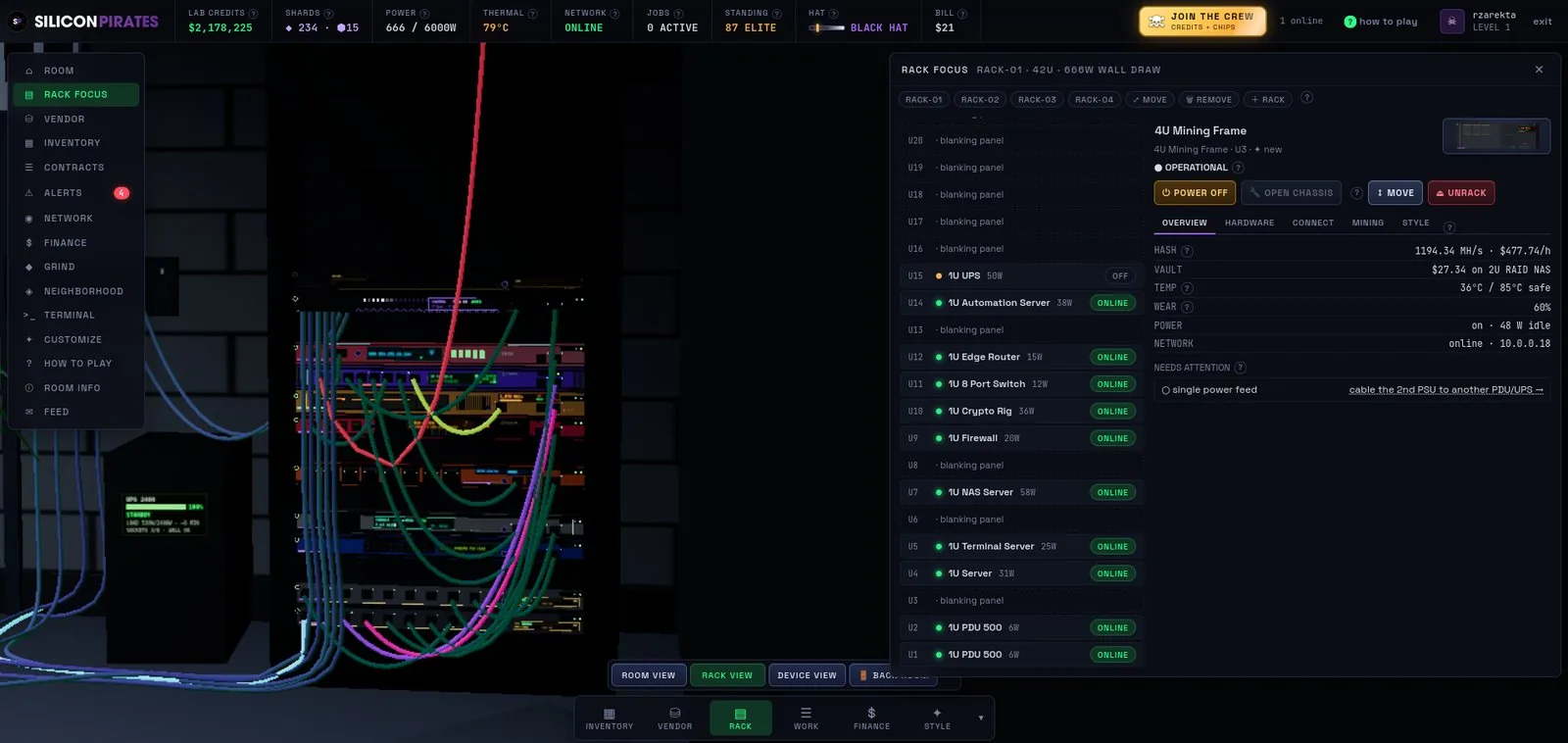
A device with two PSUs rides out losing one feed only when PSU1 and PSU2 go to two different chains. Two PSUs on the same PDU, or on two PDUs chained off each other, are not redundant: one switch takes both feeds.
Upgrading in place
Open the PDU's HARDWARE tab. TIERS lists the bigger units with their prices. UPGRADE swaps it where it sits: a tech does it for 2 Chips, a $60 fee and the unit's price, unless you already have one on the shelf. The slot, the cables, the switch and the settings are kept. The old unit goes to your inventory. At the terminal: upgrade <pdu>.
The 1U PDU 500 feeds 500 W. The 1U PDU 1500 feeds a whole wall circuit.
See also: Power in the game systems reference · 1U UPS · 1U PDU 500.